If you’ve been scrolling through photography communities lately, you’ve probably seen conversations about AI buzzing everywhere—and honestly? It’s not going away. From the Chicago photographer situation that sent shockwaves through our industry to clients casually uploading your work into generative AI tools, the legal landscape for photographers is shifting faster than we can keep up. But here’s the thing: you don’t have to panic. You just need to be prepared.
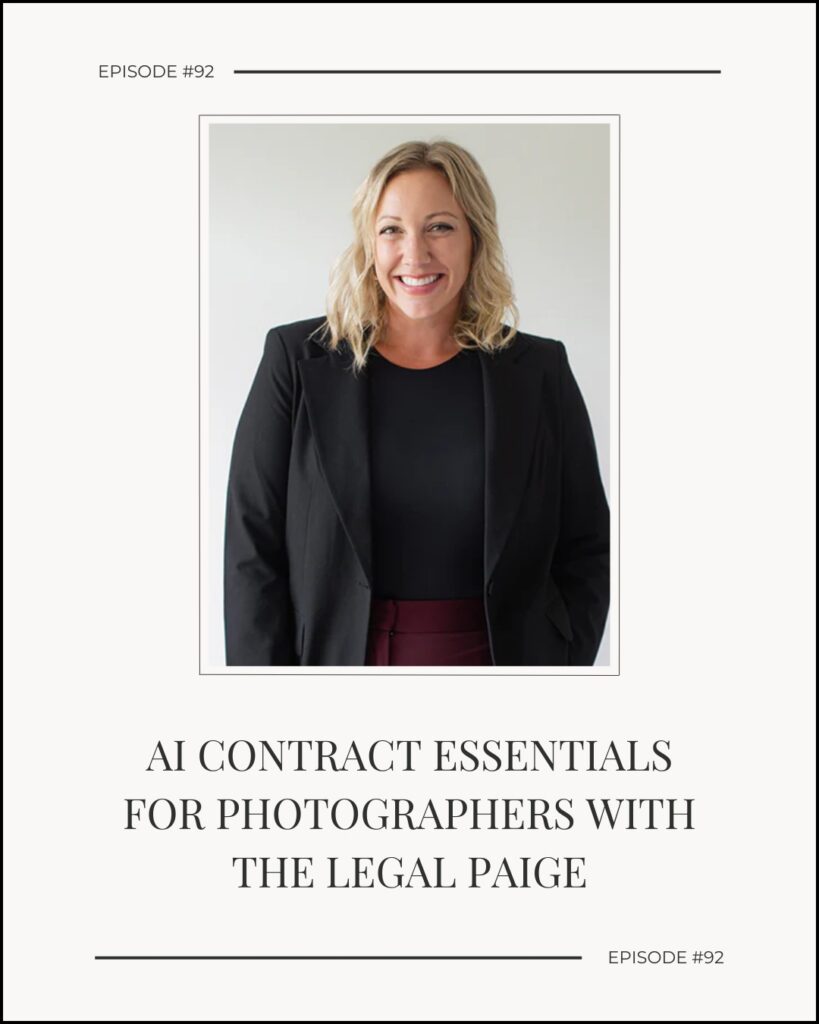
In this episode, I’m sitting down with Paige Griffith from The Legal Paige to walk through exactly what you need to have in place right now to protect your photography business, your copyright, and your clients. We’re talking about the AI tools you’re using in your workflow (Lightroom’s generative features, editing software, culling platforms, client communication tools), what happens when clients use AI on the photos you’ve delivered, and most importantly—what contract clauses actually protect you when things go sideways.
Whether you’re already using AI in your business or you’re on the fence about it, this conversation is essential. The legal layer hasn’t caught up yet, which means photographers who get ahead of this now are going to be the ones sleeping soundly at night.
Listen to the episode below, or keep reading for a summary of what’s covered.
spotify | apple podcast | stitcher
Why AI Matters to Your Photography Business Right Now
Let me be honest with you: AI isn’t just about the fancy tools you’re using to edit faster or communicate smarter with clients. It’s become a two-sided issue in our industry, and if you’re not thinking about both sides, you’re leaving your business vulnerable.
On one side, you have your own use of AI. You’re using it in your workflows—culling software that leverages AI, Lightroom’s generative tools to clean up backgrounds, automations for client communication, even voice-to-text transcription that becomes blog posts for your website. These tools are genuinely helpful and they’re making our jobs easier. That’s not the problem. The problem is that most photographers have zero language in their contracts about how they’re using these tools with their clients’ final deliverables.
On the other side, you have clients using AI. And this is where it gets tricky. Your clients are taking the photos you’ve delivered—photos they purchased with a personal license to use—and uploading them into AI generators to change things. They’re asking AI to “make us look happier” or to create a vintage version of their family photo. They’re not being malicious about it. They genuinely don’t understand that it’s copyright infringement or that it could create liability for you. They think they bought the photos, so they can do whatever they want with them.
The reality? Both situations need to be addressed in your contract before they become problems.
Paige puts it perfectly: “There’s just a lot of issues here. We have to assume clients are doing this now. They are doing it. It’s everywhere.” And she’s right. I’m seeing it in Facebook groups daily. Photographers discovering that clients have uploaded their candid documentary work into AI and manipulated it beyond recognition—and now wondering if that’s even still their work, or if their name should even be attached to it.
The Chicago Photographer Situation: A Cautionary Tale
If you haven’t heard about what happened in Chicago, let me give you the quick version. A photographer was taking images from other photographers’ portfolios, uploading them into AI, manipulating them, and then using them as their own work to attract clients. This wasn’t a client misunderstanding what a personal license means. This was intentional copyright infringement for commercial purposes.
But here’s what’s important: this situation actually represents two different legal issues happening at once.
The first is the blatant copyright infringement—using another photographer’s work commercially without permission. That’s a huge problem, obviously.
The second issue, though? AI training. When someone uploads your photos into an AI platform, that platform can be trained on your work—your composition, your editing style, your artistic choices. Your creative DNA is being used to train AI without your permission and without any compensation. That’s happening whether the person uploading is being malicious or not.
“Your composition, your editing style, your artistic choices—if it’s trained on it, it was being trained on it without your permission and without any compensation,” Paige explains. “So that’s a copyright concern again.”
This is why the language in your contracts matters so much. It’s not just about protecting yourself from intentional bad actors. It’s about setting clear boundaries before the gray areas become problems.
How Photographers Are Using AI (And What You Need to Disclose)
Let’s talk about your side first—the tools you’re actually using in your business.
AI is everywhere in photography workflows now. It’s not just Lightroom’s generative fill tool (though that’s a big one). You’re using:
- Culling software that uses AI to help you sort through thousands of images faster
- Editing platforms that use AI to assist with adjustments
- Client communication tools that automate responses and scheduling
- Voice-to-text transcription that turns your wedding day voice notes into blog content
- Website copy tools that help you write everything from landing pages to email sequences
- Discovery call recording and transcription tools that some photographers are using to document conversations with clients
Here’s what Paige made really clear: the issue isn’t that you’re using these tools. It’s that you’re using them on your client’s final deliverables without telling them. And if you’re manipulating those deliverables with generative AI in significant ways, you might actually be creating a copyright problem for yourself.
“If you’re manipulating them beyond just one to two percent of their image—taking out a tiny little trash can and the generative options are just helping you mask that and put over a nice piece of grass that’s right next to it—that’s different from completely changing the sky or completely changing very significant features or aspects of that photo,” Paige explains.
And here’s the copyright piece that hits different: the U.S. Copyright Office is clear that you don’t own a copyrighted work if it wasn’t largely human-created. We’re talking more than 50% human-created, ideally more like 90-95% for photographers.
Think about it. You’re the one who composed the shot, set up the lighting, captured the moment. That’s human creation. But if you’re using generative AI to change a third of the image—or worse, half the image—you might be crossing into territory where you no longer own the copyright to what you’ve delivered.
That sounds scary, but it’s also fixable. It just requires one specific clause in your contract: a disclaimer about your use of AI.
The AI Disclaimer Clause: What It Is and Why It Protects You
This is the big one, friend.
The AI disclaimer clause is a short addition to your contract that tells your clients upfront: “I use AI-assisted tools in my workflow, including [whatever tools you’re using]. Here’s what that means for you, and here’s why it doesn’t affect your ownership experience.”
What this clause does is create an affirmative statement that all of your final deliverables are still largely human-created by you. You shot it. You composed it. You made the artistic decisions. AI just helped you along the way—maybe with some of the technical heavy lifting, but the creative vision is 100% yours.
“Without that clause, you’re kind of just hoping that your client never asks or never cares,” Paige says. “But it may not be an issue now, it could be an issue in a year or two.”
And she’s predicting this becomes a bigger issue. As clients get smarter about what photographers do, more of them are going to start asking. Couples considering hiring you will want to know: Did AI help edit my photos? Am I paying for human artistry or AI-generated content?
By putting this clause in your contract, you’re being transparent, you’re protecting your copyright ownership, and you’re actually building trust with clients by being honest about your process.
The disclaimer also addresses another layer that a lot of photographers don’t think about: client communication, recording, and voice data. Some states require two-party consent to record someone, and your clients have the right to know if you’re using AI tools that record or transcribe your discovery calls. Paige makes the point that transparency isn’t just a legal requirement—it’s an honesty issue.
“What are you doing with me and my likeness and my image and my kids’ images? What are you doing with my voice or any calls that we have together? What are you doing with my emails and potentially my personal information?” These are questions clients increasingly want answers to.
What Happens When Clients Use AI on Your Photos
Now let’s talk about the other side of this equation—and honestly, this is the part that caught me off guard a bit.
Your clients are uploading your photos into AI generators. Right now. Today. This isn’t a theoretical problem.
Paige shared a real example from a Facebook group: A photographer delivered a candid, documentary-style wedding photo. The client uploaded it into AI and asked it to “make me and my husband look happier.” The AI platform manipulated the image, put them together smiling, and suddenly it wasn’t candid or documentary anymore—it was AI-generated.
And here’s the kicker: the client didn’t see anything wrong with that. They bought the photos, right? So they can do what they want?
Not exactly. And that’s where your contract comes in.
When you deliver photos to a client, you’re giving them a personal license to use, not ownership. That license has limits. Historically, those limits have been things like: don’t add Instagram filters, don’t crop the image in a way that changes the composition, don’t significantly alter it. But nobody was thinking about AI back then, so most contracts say absolutely nothing about it.
Here’s what can happen when clients use AI on your photos:
Copyright training. Your composition, editing style, and artistic choices are being fed into AI systems without your permission. Over time, AI models trained on thousands of photos like yours are learning to replicate your style without compensating you or asking permission.
Defamation and deepfakes. AI can manipulate images of real people in ways that are offensive, defamatory, or create deepfakes. If your name or metadata is attached to those images, you could face liability even though you didn’t create the manipulation.
Derivative works. Your client is creating new versions of your work—derivations—and they don’t have the right to do that. In copyright law, only the copyright holder has the right to create derivatives. When a client uses AI to create “15 more photos off of five images that you gave them,” they’re violating your copyright.
The last one is especially important when clients are using other photographers’ work as inspiration. Paige shared: “They saw a wedding image last year of another photographer that they couldn’t afford. It was one of the reasons they booked the venue and they asked you to take it, but you put your own artistic spin on it because why would you want to absolutely duplicate another amazing photographer’s work? That’s the industry we’re all in… But then the client takes your image and they take it and they create the other one with AI. And so now it looks like the other photographer’s work.”
That’s not good for anybody—not for you, not for the original photographer, and honestly, not for the client either. But they don’t know better unless you tell them in your contract.
The Three Contract Clauses You Need Right Now
Okay, so you’re convinced you need to protect yourself. Where do you actually start?
Paige breaks it down into three specific areas of your contract that need updating or adding:
1. The AI Disclaimer Clause (for your use of AI)
This goes in your main contract and explains the AI tools you’re using in your workflow. It tells clients that you’re using AI-assisted tools (be specific about which ones), that these tools help you deliver the best final product, and that all of your deliverables are still largely human-created by you.
This protects your copyright ownership. It’s your affirmative statement that you still own what you’re delivering.
2. The Personal License to Use Clause (updated for AI)
This is where you spell out exactly what clients can and cannot do with their photos. And now, it needs to explicitly state that the client’s license does not include uploading images into AI systems, using them to train AI models, or creating AI-generated derivative works.
“You need to make sure that your photography contract has a license clause,” Paige explains. “And that license clause right now doesn’t say anything about AI. And then you’re going to move it so that it does say something about AI.”
You’re essentially drawing a line in the sand: You bought the right to print these, frame these, share these on social media. You did not buy the right to feed them into generative AI.
3. The Copyright and Intellectual Property Clause (beefed up for AI)
This clause protects your ownership of the images as creative works. It makes clear that AI-generated manipulations of your photos are not new IP rights for the clients. They can’t own those derivatives. Only you can.
This clause works hand-in-hand with your personal license to use clause. Together, they’re saying: I own this. You can use it within these boundaries. Creating AI derivatives is outside those boundaries. That’s copyright infringement.
What About Your Website Copy and Content?
Here’s something I didn’t fully think through until this conversation: if you’re using AI to create content for your website, you need a separate clause too.
Whether you’re using AI to write blog posts, create landing page copy, write email sequences, or optimize SEO on your website—all of that needs an AI disclaimer in your website terms and conditions.
“If you’re using AI for your blogs and things along those lines, you also need a disclaimer in your website terms and conditions,” Paige explains. “You got to have a website terms and conditions and privacy policy on the bottom footer of your website. And one thing to add to that now is an AI disclaimer clause that’s telling people you did use AI, but again, you’re making sure that you own the majority of your website.”
This is especially important because you can actually register your website with the U.S. Copyright Office—or at least certain pages of it. If you want to protect the copy you’ve written (or had written and then heavily edited and personalized), you need to be able to claim that it’s largely human-created.
Think about it: you’re using AI as a starting point, but you’re the one refining it. You’re the one making it sound like you. You’re the one adding your perspective and your voice. So yes, it’s AI-assisted, but it’s also largely your creation.
The Transparency Piece (And Why It Actually Builds Trust)
Here’s something I really appreciated about this conversation: Paige isn’t saying you shouldn’t use AI. She’s saying you should use it transparently and legally.
“I’m not saying don’t use it. That would be silly. I’m just saying use it cautiously and carefully and legally. And you don’t want to just hope that your client never asks or never cares. That’s like not a great legal position to put yourself in. So it’s better to be upfront.”
This landed for me because it reframes the whole thing. You’re not hiding anything. You’re being honest. And honest? That actually builds trust.
Think about the photographers who are already asking clients questions about privacy concerns. Some couples are coming in and saying, “I want to make sure you’re not sharing our images anywhere. I want to know about your privacy practices.” Those conversations are only going to expand to include AI.
The photographers who have their clauses in place, who can say, “Here’s exactly how I use AI in my process, here’s what I don’t do with your photos, and here’s how I’m protecting your privacy and your likeness”—those photographers are going to stand out. They’re going to sound professional and prepared. They’re not going to be scrambling to figure it out mid-conversation with a worried couple.
When You’re a Brand or Commercial Photographer
Quick note if you’re a commercial or brand photographer rather than a wedding or family photographer: the rules are a little different for you.
With commercial clients, you typically don’t have personal licenses to use—you have commercial licenses. And you have two options:
Option one: Assign full copyright ownership to the client. This means you lose all control over how they use the images, including whether they feed them into AI. If that doesn’t feel right to you, this option might not be for you.
Option two: Offer a limited commercial license to use. You keep the copyright. You set boundaries around what they can do with the images, including AI usage restrictions.
“I think branding commercial photographers are thinking about this a lot. Like should I be doing that?” Paige says. “And the answer is probably no. You should probably be going to a lot of branding commercial photography conferences and workshops and talking to people about this.”
This is worth thinking through for yourself if you work with brands. What feels right for your business?
The Bottom Line: Protect Yourself Now, Not Later
The biggest takeaway from this whole conversation is this: Don’t wait until you have a problem to figure this out.
The law is still catching up. Copyright office rulings are still coming down. AI tools are still evolving. This is the moment to get your legal foundation solid so that when things change—and they will—you’re already protected.
Paige runs The Legal Paige because she saw photographers struggling with these exact issues. She was a photographer herself, so she understands the business. She also went to law school so she understands the legal side. And what she’s created is a way for photographers to not have to become lawyers to protect themselves.
“Your contract is the best first place to start because it’s that foundational tool that you can go back to,” Paige says. “And also it’s the first time that you’re kind of explaining to people, ‘Hey, when I deliver these images to you, I still own the copyright. Here’s what that means. Let me also put in some language here regarding AI and what you can and cannot do.'”
This isn’t about being paranoid. It’s about being professional. It’s about protecting the creative work you’re doing and the trust your clients are putting in you.
Key Takeaways
- AI is everywhere in photography workflows now—from culling to editing to client communication—and you need to disclose this to clients through an AI disclaimer clause in your contract.
- The U.S. Copyright Office requires that work be largely human-created (more than 50%) for you to own the copyright. If you’re using generative AI to change significant portions of an image, you might be putting your copyright at risk.
- Clients are uploading your photos into AI generators right now, often without realizing they’re violating your copyright or creating liability. You need explicit language in your personal license to use clause prohibiting AI usage.
- Your personal license to use clause and copyright clause work together to protect you. One tells clients what they can do, the other tells them they can’t create derivatives or own AI manipulations.
- Website copy needs AI disclaimer language too. If you’re using AI to create blog posts, website copy, or any other content on your site, you need to disclose that in your website terms and conditions.
- Being transparent about AI builds trust, not distrust. Clients appreciate honesty. Protecting yourself legally doesn’t mean hiding your process—it means explaining it clearly upfront.
- Update your contracts before you need them. Don’t wait for a problem. Get these clauses in place now while you have time to think about them clearly.
- The legal landscape is still changing. Look for contract companies that actually update your contracts as laws change, not ones that sell you a template once and disappear.
What’s Covered in This Episode
- How AI is being used in photography workflows (culling, editing, client communication, website content)
- What the U.S. Copyright Office says about AI and copyright ownership
- The Chicago photographer situation and what it teaches us about copyright infringement
- How clients are using AI on delivered photos without understanding the legal implications
- The three specific contract clauses you need: AI disclaimer, personal license to use (updated), and copyright/IP clause
- Why transparency about your AI usage actually builds client trust
- How to protect your website copy if you’re using AI to create content
- The difference between personal licenses and commercial licenses for brand photographers
- Why getting your legal foundation solid now matters more than waiting until there’s a problem
Featured Offerings or Resources Mentioned in the Episode
- The Legal Paige – where you can find all the contract clauses, templates, and resources Paige mentioned. Use code CLAIRE10 for an extra discount on top of the sale—or year-round if you’re catching this episode later.
- AI Clause Bundle for Photographers and Videographers – includes the three essential clauses (AI disclaimer, personal license to use update, and copyright/IP protection) ready to copy and paste into your contract
- AI Disclaimer Clause for Website Terms and Conditions – separate clause for protecting your website copy and content if you’re using AI to create it
- Mid-Year Sale: Everything in The Legal Paige shop is 40% off May 18-21, 2026 (site-wide), and The Legal Paige only runs two sales per year, so this is genuinely one of the best opportunities to invest in protecting your business.
- The Legal Paige Facebook Community – where photographers share legal questions and Paige answers them directly
My other favorites in The Legal Paige shop:
- Wedding Photography Contract (or specialized contracts for elopements or destination weddings)
- Second Shooter Agreement for wedding photographers who hire second shooters
- Third-Party Payer Addendum for situations where someone other than the client (like parents) is paying
- Contract Addendums and Amendments for making changes to existing agreements
- Cancellation and Rescheduling Amendment for the worst case scenario
- Website Terms and Conditions and Privacy Policy for your website
- Associate Team Contract if you have an associate team
- Styled Shoot Agreement and Model Call Contract because this protects you as the organizer and your agreement with all vendors and models
- Digital Product Agreement for those selling any kind of product through their website
- Coaching Contract for hosting a group program (there are also contracts for 1:1 coaching and online courses)
Final Thoughts
Friend, I know legal stuff can feel overwhelming. I used to be the person hoping I’d never need to worry about any of this. But the more I’ve learned about protecting my photography business and my education business, the more I realize that contracts aren’t restrictive—they’re freeing.
When you know you’re legally protected, you can relax. You can focus on the creative work you love. You can show up for your clients without the low hum of anxiety in the background wondering if you’re covered.
That’s what Paige has helped me do, and it’s why I keep coming back to The Legal Paige every time something new comes up in our industry.
If you found this episode helpful and you want more education on running a photography business that actually works for you—not against you—I’d love to have you join me for the next episode. Subscribe to the show, leave a five-star review on Apple or Spotify, and screenshot this episode and share it on Instagram tagged @itsclairehunt. I genuinely love seeing which episodes resonate with you most.
And if you’re ready to dig deeper into building the foundational business systems that protect you legally and set you up for long-term success, I’d love to talk with you about Book It—my signature 12-week mentorship program.
Until next time, my friend. Take care of your creative work by taking care of your legal foundation. You’ve got this.


